
Last updated: May 2026
I’ve spent time in both platforms. Here’s the honest answer: they’re not really competing for the same user — even though everyone treats them like they are.
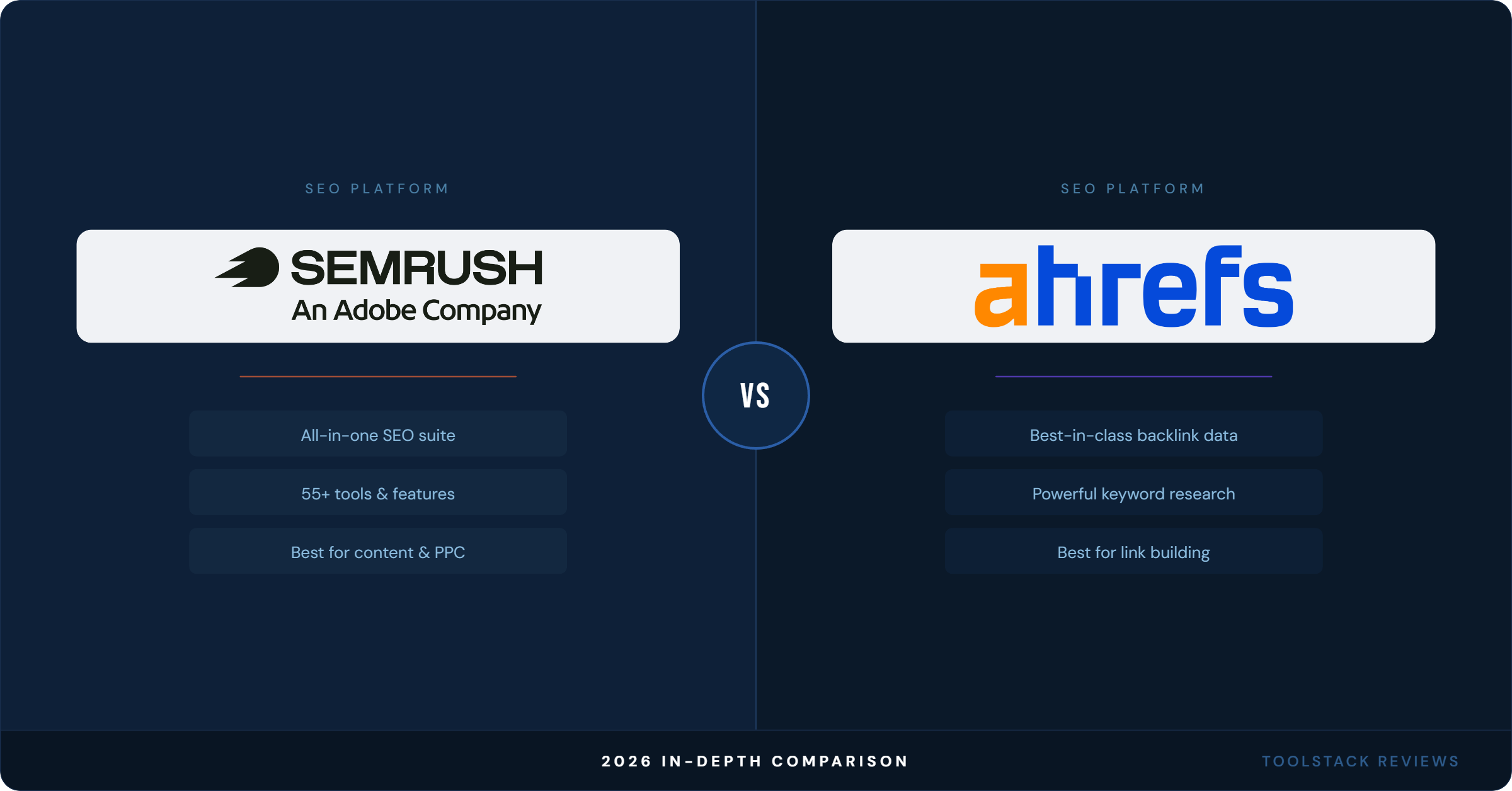
Semrush is a marketing suite that happens to do SEO really well. Ahrefs is an SEO tool that’s slowly expanding into a broader platform. If you’re a creator, solopreneur, or small business owner trying to decide where to spend $100–$250/month, that distinction matters more than any feature comparison chart.
Let me break it down.
Quick Verdict
Choose Semrush if: You want one platform for SEO *and* competitor research, paid ads intelligence, content tools, and social scheduling. You’re managing multiple projects or client sites.
Choose Ahrefs if: SEO is your primary focus, backlink analysis is a core part of your workflow, and you want the cleanest, most accurate data without the noise of extra toolkits you’ll never use.
Pricing (2026)
Semrush
Semrush now runs two parallel pricing tracks, which is more confusing than it needs to be.
SEO Classic Plans (traditional):
- Pro: $139.95/mo (or $117.33/mo annually) — 5 projects, 500 tracked keywords
- Guru: $249.95/mo (or $208.33/mo annually) — 15 projects, 1,500 keywords
- Business: $499.95/mo (or $416.66/mo annually) — 40 projects, 5,000 keywords
Semrush One (new bundle including AI Visibility tools):
- Starter: $199/mo ($165.17/mo annual)
- Pro+: $299/mo ($248.17/mo annual)
- Advanced: $549/mo ($455.67/mo annual)
For most creators and solopreneurs, the Pro plan ($117.33/mo annual) is the practical entry point. Guru makes sense when you’re managing multiple client projects or need historical data.
Ahrefs
Ahrefs recently simplified their entry point significantly. In January 2026 they launched a $29/mo Starter plan — a 70%+ price drop from their previous minimum.
- Starter: $29/mo (monthly only, no annual) — 1 project, 50 tracked keywords, 1 month history
- Lite: $129/mo (~$108/mo annual) — 5 projects, 750 tracked keywords
- Standard: $249/mo (~$199/mo annual) — 20 projects, 2,000 keywords *(most popular)*
- Advanced: $449/mo (~$399/mo annual) — 50 projects, 5,000 keywords
- Enterprise: from $1,499/mo
The Starter plan is genuinely useful if you just need keyword research and occasional competitor lookups. For anything resembling a real workflow, you’re looking at Standard at $199/mo annual.
Pricing Verdict
Ahrefs has the edge here for pure SEO users. The Standard plan at $199/mo gives you more than Semrush Pro at $117/mo in terms of raw SEO capability — 2 years of historical data, 20 projects, and a significantly larger keyword database. If you add up what you’d actually use in Semrush’s full suite, Semrush can offer better value — but only if you use those extra tools.
Core SEO Features
Keyword Research
Semrush: 25.5 billion keyword database (per Semrush’s published product specs, 2026). Strong keyword difficulty scoring, intent mapping, and the Keyword Strategy Builder that auto-maps content architecture from seed keywords. Good for ideation at scale.
Ahrefs: 28.7 billion keywords with 110 billion discovered total (per Ahrefs published specs, 2026). Arguably the cleaner interface for keyword research, with strong SERP history, parent topic grouping, and search intent classification baked in.
Verdict: Ahrefs edges out Semrush on raw keyword data volume and research workflow UX. Semrush’s Keyword Strategy Builder is genuinely impressive for content planning, which partially closes the gap.
Backlink Analysis
This is where Ahrefs built its reputation, and it still holds.
Semrush: Solid backlink data, good for audits and gap analysis. Part of the broader toolset.
Ahrefs: Crawls 8 billion+ pages per day and maintains approximately 35 trillion indexed links — the largest backlink index among major SEO tools (per Ahrefs published specs, 2026). Independent tests have consistently ranked Ahrefs as the fastest to discover new backlinks, typically 24–48 hours ahead of competitors. The backlink database is the industry benchmark.
Verdict: Ahrefs wins this decisively. If backlinks are a meaningful part of your SEO strategy, this alone can justify the platform choice.
Technical SEO Audit
Semrush: 140+ checks across 7 categories. Fast crawl speed (~100 pages in 3 min), AI-filtered issue prioritization, and solid integration with Google Search Console.
Ahrefs: 170+ on-page and technical checks. Launched “Always-On Audits” in April 2025 — 24/7 continuous monitoring that alerts you when critical issues appear, not just when you manually trigger a crawl.
Verdict: Call it a tie. Semrush has more checks; Ahrefs has always-on monitoring. Both handle technical audits well at this price point.
Rank Tracking
Both platforms track rankings by device and location with SERP feature breakdowns (featured snippets, AI Overviews, PAA boxes). Both are solid here.
Semrush added AI Overview position tracking to its Sensor tool. Ahrefs has a cleaner rank tracker UX.
Verdict: Tie. Pick your preference.
Where They Genuinely Differ
Competitive Intelligence
Semrush is the clear leader for competitive intelligence beyond SEO. You can see a competitor’s paid search keywords, ad copy, estimated ad spend, and media buying strategy — none of which Ahrefs offers.
If you run or manage paid ads at all, Semrush’s advertising intelligence alone can justify the subscription. Ahrefs simply doesn’t have this.
Content & Social Tools
Semrush bundles content marketing tools, social scheduling, brand monitoring across Facebook/Instagram/X/TikTok/YouTube, and an AI writing assistant (ContentShake AI). It’s a full digital marketing platform.
Ahrefs has Content Explorer (great for content ideation and link prospecting) but is only now building out social features in beta. It’s not competing on this front yet.
AI Visibility Tracking
Both platforms now track brand presence in AI search engines — this is the newest battleground in SEO.
Semrush AI Visibility Toolkit: $99/mo standalone or bundled in Semrush One. Tracks ChatGPT, Gemini, and Google AI Mode.
Ahrefs Brand Radar: From $199/mo standalone, or included in higher plans. Tracks 6 platforms: ChatGPT, Perplexity, Gemini, Copilot, Google AI Overviews, and AI Mode. Also scans 16 billion web pages for brand mentions.
Verdict: Ahrefs Brand Radar is the more comprehensive AI visibility product — it covers more AI platforms and has deeper analysis. The price difference ($199/mo vs $99/mo) reflects it.
API & Integrations
Semrush: API access from Advanced plan ($549/mo annual). White-label reporting available. Good for agencies.
Ahrefs: API only from Enterprise ($1,499/mo). Has a native MCP integration so Ahrefs data surfaces directly inside ChatGPT and Claude — genuinely useful for AI-powered workflows.
Who Should Use Each
Use Semrush if you:
- Run or manage paid search campaigns alongside SEO
- Need to monitor social media or schedule content
- Work with multiple clients or projects at once
- Want one platform for the full digital marketing stack
- Are primarily focused on competitive intelligence
Use Ahrefs if you:
- Are focused primarily on SEO with backlinks as a core tactic
- Want the most accurate, cleanest backlink data available
- Do content-led SEO and rely on keyword research and content gap analysis
- Work on a single site or small number of sites
- Want a cleaner, less cluttered interface
For creators and solopreneurs specifically:
If you’re building a personal brand, running a newsletter, growing a blog, or running a service business — Ahrefs Standard at $199/mo is the better starting point. The data is better for pure SEO, the interface is more approachable, and the $29/mo Starter is a genuinely useful way to test the waters before committing.
If you’re running paid ads or managing clients, Semrush Pro or Guru gives you enough in one place that it replaces several separate tools.
ToolStack Verdict
Best for SEO-first users: Ahrefs
Best for full marketing stack: Semrush
Best entry point to try: Ahrefs Starter — $29/mo
Frequently Asked Questions
Is Ahrefs or Semrush better for beginners?
Ahrefs. The interface is cleaner, the Starter plan at $29/mo is a low-risk entry point, and the core workflow (find keywords → audit site → build links) is straightforward. Semrush has more tools but that breadth can be overwhelming when you’re starting out.
Can I use both Semrush and Ahrefs together?
Some agencies and power users do, but for most solopreneurs and creators it’s overkill. Pick one, get good at it, and revisit in 12 months if you’re hitting its limits.
Does Semrush have a free trial?
Yes — Semrush offers a 7-day free trial on Pro and Guru plans. Ahrefs doesn’t offer a free trial, but the $29/mo Starter plan is low-commitment enough to serve the same purpose.
Which tool is better for local SEO?
Semrush. It has a dedicated Local SEO toolkit ($30–$60/mo) with listing management, map rank tracking, and Google Business Profile tools. Ahrefs is building toward this but isn’t there yet.
Which tool tracks AI search rankings?
Both now. Ahrefs Brand Radar covers more AI platforms (6 vs Semrush’s 3) and is generally considered the more mature AI visibility product. Semrush’s AI Visibility Toolkit is more tightly integrated with their existing dashboard.
*Disclosure: Some links in this article are affiliate links. If you sign up through them, we may earn a commission at no extra cost to you. We only recommend tools we’ve actually evaluated.*
⬇ FREE DOWNLOAD
Get The Lean Creator Stack
8 tool categories. Best free + paid picks for solopreneurs in 2026.