
Last updated: July 2026
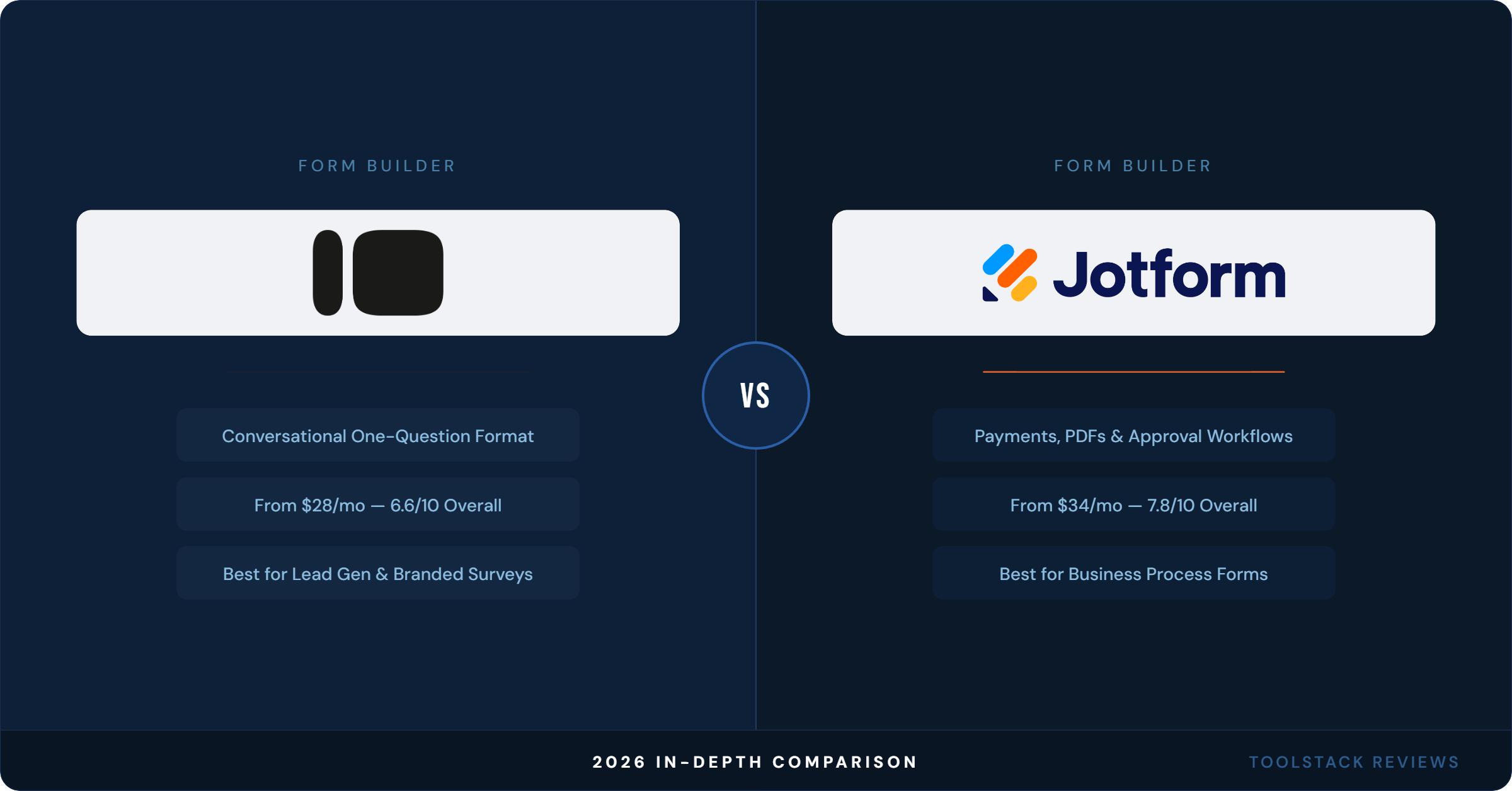
Typeform makes forms feel like a conversation. Jotform makes forms do actual work — payments, e-signatures, PDFs, approvals. If you’ve narrowed your form builder search to these two, you’re really choosing between design and depth, and the price gap between them is bigger than most comparison posts let on.
Typeform vs Jotform 2026: The Short Answer
Pick Typeform if the form itself is the product — a lead magnet, a quiz, an onboarding flow where completion rate and brand feel matter more than raw functionality. Pick Jotform if the form is a step in a business process — collecting payments, generating PDFs, routing approvals, or storing thousands of submissions in a database you’ll actually query later. According to Typeform’s own homepage copy (retrieved July 2026), the platform processes “over 48 million responses” a month and claims its conversational format can double completion rates versus a traditional form. Jotform counters with volume: its official pricing page states it has “150+ integrations” and is used by “over 35 million users worldwide.”
Typeform Pricing 2026: Every Plan, Verified
Pulled directly from typeform.com/pricing this session — these are the annual-billing rates; monthly billing costs more per plan:
- Free — $0. Typeform’s public pricing page doesn’t list the free-tier response cap outright as of July 2026; third-party trackers report it’s extremely limited (commonly cited around 10 responses/month), so verify at typeform.com before building a workflow around the free plan.
- Basic — $28/month (billed annually). 1 user, 100 responses/month included, unlimited typeforms and questions, AI-powered form creation, conditional logic, webhooks and integrations.
- Plus — $56/month (billed annually). 3 users, 1,000 responses/month, everything in Basic plus removed Typeform branding and a custom subdomain.
- Business — $91/month (billed annually). 5 users, 10,000 responses/month, drop-off rate analytics, conversion tracking, priority support and live chat.
- Growth Flow — $266/month, 14-day free trial (credit card required). 5 users, 10,000 responses/month with 1,500 enriched responses/month included, Salesforce integration, email and SMS follow-ups, Smart Insights.
- Talent (HR-specific) — $119/month. 3,000 responses/month, 3 users, video Q&A, ReCAPTCHA, multi-language support.
- Enterprise — custom pricing, 6+ users, SSO, dedicated Customer Success Manager, HIPAA and GDPR options.
Two add-ons worth knowing about before you budget: the Contacts & Automations add-on runs an extra $25/month (annual) for 2,400 actions or $75/month for 12,000 actions, and it’s only available on plans above Basic. That’s a real cost most reviews skip past.
Jotform Pricing 2026: Every Plan, Verified
Jotform’s official pricing page confirms five tiers — Starter, Bronze, Silver, Gold, Enterprise — with prices cross-checked against three independent 2026 pricing trackers (Emitrr, Zite, and Supatool) since Jotform’s own numeric pricing widget didn’t render in a plain-text pull:
- Starter — Free. 5 forms, 100 monthly submissions, 100 MB storage, 10 monthly signed documents. Jotform branding included and cannot be removed on this tier.
- Bronze — $34/month billed annually ($39/month billed monthly). 25 forms, roughly 1,000 monthly submissions, no Jotform branding.
- Silver — $39/month billed annually ($49/month billed monthly). 50 forms, roughly 2,500 monthly submissions, 10 GB storage.
- Gold — $99/month billed annually ($129/month billed monthly). 100 forms, 100 GB storage, 1,000 fields per form, optional HIPAA compliance, up to 10,000 monthly submissions.
- Enterprise — custom. The only multi-user Jotform plan, adding SSO, custom domains, and dedicated support.
Jotform also runs a 30-day money-back guarantee on paid plans and a standing 50% nonprofit/education discount on Bronze, Silver, and Gold — both facts confirmed directly on jotform.com’s pricing FAQ this session. Note that the Gold plan caps payment submissions at 1,000/month even though it markets itself as the high-volume tier — a limit several third-party breakdowns (including Emitrr’s 2026 pricing guide) call out specifically.
Where the Money Actually Goes: Head-to-Head Pricing
| Tier | Typeform (annual) | Jotform (annual) |
|---|---|---|
| Entry paid plan | Basic — $28/mo, 100 responses, 1 user | Bronze — $34/mo, ~1,000 submissions, unlimited seats aren’t offered until Enterprise on either tool |
| Mid tier | Plus — $56/mo, 1,000 responses, 3 users | Silver — $39/mo, ~2,500 submissions |
| High-volume tier | Business — $91/mo, 10,000 responses, 5 users | Gold — $99/mo, up to 10,000 submissions, HIPAA option |
The headline number that should shape your decision: at the mid tier, Jotform’s $39/month Silver plan allows roughly 2,500 submissions, while Typeform’s $56/month Plus plan caps out at 1,000 responses. If your form is a high-volume lead-gen or intake tool rather than a boutique survey, Jotform’s per-response cost is meaningfully lower.
Feature Comparison: Design vs Depth
What Typeform does better
According to a 2026 comparison from Knack, Typeform “earns consistent praise for its clean design and engaging, conversational form flow,” with reviewers highlighting the one-question-per-page format for surveys and lead generation. Typeform’s own site states its conversational format is built to more than double completion rates versus a standard form. Typeform’s analytics are comparatively thin, though — Feathery’s 2026 comparison notes Typeform “offers only basic metrics like overall completion rate and does not natively support running A/B tests.”
What Jotform does better
Jotform wins on breadth of use case. Per Formgrid’s 2026 comparison, “Jotform provides more comprehensive analytics across all plans: form views, submission rates, completion time trends, and conversion rate tracking over time,” plus Jotform Tables for storing submissions in a browsable database and Jotform Reports for generating presentation-style exports. Jotform also supports more field types, native e-signatures via Jotform Sign, PDF generation, approval workflows, and a wider range of payment processors — Stripe, PayPal, Square, Authorize.Net, and Venmo are all listed as native integrations on Jotform’s official pricing page.
Integrations
Jotform’s pricing page lists 150+ integrations spanning CRMs (Salesforce, HubSpot, Zoho, Pipedrive), automation platforms (Zapier and Make), and payment processors. Typeform’s own integrations blog groups its connections into categories including analytics (Google Analytics, Airtable, Notion), automation (Zapier, Make, Chili Piper), and CMS (HubSpot, Webflow, Contentful) — a narrower but still solid set aimed more at marketing stacks than back-office workflows.
Ratings: What Users Actually Say
Per a 2026 aggregator review (idealonlinebusiness.com, cross-checked against Knack’s independent 2026 comparison), Typeform holds a 4.5/5 rating on G2 across 700+ reviews and a 4.7/5 on Capterra. Jotform, according to Signeasy’s 2026 review roundup, holds a 4.7/5 rating on G2 across 700+ reviews and the same 4.7/5 on Capterra across 400+ reviews. Both platforms land in the same rating band — the difference shows up in what reviewers complain about, not the star count. Knack’s comparison specifically flags Jotform’s “clunkier UI” against Typeform’s design, while Signeasy’s roundup flags Jotform’s “pricing escalation” and “folder organization limits” as the most common negative themes in verified reviews.
Affiliate Programs: Which One Actually Pays
This matters if you’re evaluating these tools as a monetizable recommendation, not just a personal pick. Jotform’s own affiliate program page (jotform.com/blog, 2026) states affiliates earn “a 30 percent commission on every new paid user you refer, and that commission continues for the customer’s first year as a subscriber,” with a 60-day attribution window. Typeform’s program, per a 2026 roundup from Reclaim.ai, pays “$20 upfront plus 15% recurring commission on their monthly subscription fees, with total earnings capped at $500 per referral” — a hard ceiling Jotform’s program doesn’t have. On paper, Jotform’s affiliate economics are stronger for anyone building recurring income off referrals; Typeform’s payout structure caps out fast on higher-value customers.
Which One Fits Your Actual Use Case
Most comparison articles stop at pricing and ratings. The decision usually comes down to what the form is for, not which one “wins” in the abstract.
Lead generation and marketing forms
If you’re running paid traffic to a quiz or a lead magnet opt-in, Typeform’s conversational format is worth testing. CustomJS’s 2026 form-builder comparison states that Typeform’s “conversational interface can improve completion rates by 20-30% compared to traditional forms” for B2C audiences specifically — the same source notes the gap narrows for B2B or technical audiences, where a straightforward Jotform layout performs just as well. If your funnel depends on squeezing out every extra percentage point of opt-in rate, that 20-30% swing can outweigh the higher per-response cost.
Client intake, onboarding, and internal operations
Jotform is the stronger pick the moment a form needs to do something after it’s submitted — trigger an approval chain, generate a signed PDF, collect a deposit via Stripe, or route data into Jotform Tables for reporting. None of that requires an add-on the way Typeform’s Contacts & Automations tier does; it’s built into the core plans.
Surveys and customer feedback
Both handle straightforward NPS and feedback surveys fine. The deciding factor here is usually brand: if the survey link is going out under a polished marketing brand where every touchpoint matters, Typeform’s design edge shows. If it’s an internal or operational feedback loop where nobody’s judging the aesthetics, Jotform’s cheaper mid-tier plan does the same job for less.
Time to first working form
Both tools ship pre-built templates and drag-and-drop builders, so neither has a meaningful setup-time advantage for a simple form. Where they diverge is on complex logic: Typeform’s branching and conditional logic are built for a linear conversational flow, while Jotform’s conditional logic sits alongside a much larger library of field types (file uploads, appointment scheduling, e-signatures) that take longer to configure correctly but cover more ground once they’re set up.
ToolStack Verdict
| Category | Typeform | Jotform |
|---|---|---|
| Design & UX | 9/10 | 6/10 |
| Feature depth | 6/10 | 9/10 |
| Pricing value | 6/10 | 8/10 |
| Integrations | 7/10 | 8/10 |
| Analytics | 5/10 | 8/10 |
| Overall | 6.6/10 | 7.8/10 |
Bottom line: Jotform is the better all-around value for solopreneurs and small businesses that need forms to actually process data, take payments, or generate documents. Typeform earns its premium only when the form’s design directly drives conversions — high-stakes lead gen, branded surveys, or customer-facing quizzes where a polished, one-question-at-a-time flow is worth paying 2-3x more per response.
FAQ
Is Typeform or Jotform cheaper for a small business collecting under 1,000 responses a month?
Jotform. Its $34/month Bronze plan (annual billing) covers roughly 1,000 submissions, while Typeform’s equivalent Plus plan is $56/month for the same volume.
Does Typeform have a truly free plan?
Yes, but Typeform doesn’t publish the exact free-tier response cap on its current pricing page — check typeform.com directly before relying on it, since third-party trackers report the limit is very low.
Which tool has better payment processing built in?
Jotform, by a wide margin. Its official pricing page lists native integrations with Stripe, PayPal, Square, Authorize.Net, and Venmo, plus a dedicated payment submission limit tracked separately from standard form submissions.
Can I remove branding on the free plans of either tool?
No. Jotform’s free Starter plan keeps Jotform branding on all forms and signed documents; branding removal requires a paid plan on both platforms.
Which affiliate program pays more for referring these tools?
Jotform’s program pays a flat 30% recurring commission for a referral’s first year with no earnings cap, per Jotform’s own affiliate page. Typeform pays $20 upfront plus 15% recurring but caps total earnings at $500 per referral, per Reclaim.ai’s 2026 affiliate program roundup.
⬇ FREE DOWNLOAD
Get The Lean Creator Stack
8 tool categories. Best free + paid picks for solopreneurs in 2026.