
Last updated: July 2026
Kit (the platform everyone still calls ConvertKit out of habit) just raised prices again, and the free plan is still the most generous one in email marketing. Those two facts are both true at the same time, and that’s why this review needed a full rewrite. If you’re a creator picking an email tool in 2026, the math has changed since last year.
What Is Kit (ConvertKit) in 2026?
Kit is an email marketing platform built specifically for creators: bloggers, YouTubers, podcasters, and course sellers who want to grow an audience and sell to it without hiring a marketing team. It rebranded from ConvertKit to Kit in 2023, but the product identity hasn’t budged. Tagging over rigid lists, a visual automation builder, and native tools for selling digital products, paid newsletters, and subscriptions remain the core pitch.
Six hundred thousand-plus creators run their lists on Kit, according to the company’s own 2026 numbers, and its site pulls more than 6.19 million monthly visits, per an EmailDeliverabilityReport analysis published this year. Names like Tim Ferriss, James Clear, and Ali Abdaal use it. That’s proof this isn’t a tool built for enterprise marketing teams; it’s built for one-person operations that need to run like a real business.
Kit Pricing 2026: What Changed and What It Actually Costs
Kit runs three tiers, and the paid tiers got noticeably more expensive over the past year.
- Newsletter (Free): $0/month for up to 10,000 subscribers. Unlimited landing pages, unlimited opt-in forms, and unlimited email sends, but only one automated email sequence, verified directly on kit.com/pricing.
- Creator: $39/month billed monthly, or $33/month ($390/year) if you pay annually, for up to 1,000 subscribers. Unlocks the full visual automation builder, unlimited sequences, and free migration from another platform.
- Creator Pro: $79/month billed monthly, or $66/month ($790/year) annually, also for up to 1,000 subscribers. Adds subscriber engagement scoring, Facebook custom audience syncing, a free SparkLoop referral program (Kit values this at $99/month on its own), and priority 24/7 support.
Both paid plans scale with your list size. At 3,000 subscribers, Creator runs roughly $59/month; at 5,000 it climbs to around $89/month, according to EmailToolTester’s 2026 pricing breakdown. That subscriber-based pricing model is identical in structure to ActiveCampaign’s: the more your list grows, the more you pay, regardless of which plan you’re on.
Here’s the part that matters if you used Kit a year ago. The Creator plan’s entry price jumped from $29/month to $39/month for monthly billing, a roughly 35% increase that rolled out around September 2025, according to threads on r/Emailmarketing and a breakdown from EmailOctopus. If you locked in the old rate, hang onto it. New signups don’t get that option.
One cost that’s easy to miss: every plan, including free, carries a 3.5% + 30¢ transaction fee on any digital product or subscription you sell through Kit, inclusive of credit card processing. Kit’s own cut of that is 0.6%. If you’re using Paid Recommendations to earn from promoting other creators, Kit takes 23.5% of those earnings on Creator and Pro. None of this is hidden, but none of the marketing pages lead with it either. Check the fine print on kit.com/pricing before you commit to the commerce features.
ConvertKit Review 2026: What You Actually Get for the Price
Where Kit earns its reputation is the free plan. Ten thousand subscribers at zero cost is the highest free-tier subscriber cap in email marketing, according to a 2026 pricing guide from Sasanova. Beehiiv’s free tier caps lower, and Mailchimp’s free plan caps at 500 contacts. The catch on Kit’s free plan is that it has no visual automation builder. If your workflow depends on multi-step automated sequences, you’re paying for Creator on day one.
Once you’re on a paid plan, the visual automation builder is genuinely capable. You can build funnels with conditional branches based on tag, purchase, or link click, without touching code. The Creator Network (Kit’s built-in cross-promotion system between creators) is a differentiator competitors haven’t matched. Subscribers opt into recommendations from other newsletters, and you get paid $1 to $5 or more per signup you drive to someone else’s list.
Kit’s commerce tools are also further along than most email-first platforms. You can sell digital products, run paid subscriptions, accept tips, and host newsletter sponsorships without leaving the app. That’s a real advantage over tools like Mailchimp or GetResponse, which treat commerce as a bolt-on.
Kit vs ActiveCampaign: Where Kit Loses
Kit is not the strongest automation platform on the market, and it doesn’t try to be. EmailToolTester’s 2026 head-to-head argues that ActiveCampaign’s automation logic, landing page builder, and reporting dashboard are meaningfully more advanced. Kit’s simplicity is a feature for creators, but a limitation for anyone running complex, multi-channel campaigns or needing a built-in CRM.
The search data backs up who each tool serves. Google search volume for ActiveCampaign runs roughly double Kit’s, per that same comparison, reflecting ActiveCampaign’s pull with SMBs and agencies rather than solo creators. If you’re running e-commerce automation, lead scoring, or a sales pipeline alongside email, ActiveCampaign is the better fit. If you’re a newsletter writer, course seller, or YouTuber monetizing an audience, Kit’s narrower focus is exactly the point.
Ratings: What Real Users Say in 2026
On G2, Kit holds a 4.4 out of 5 average across 230-plus verified reviews as of mid-2026. On Capterra, it’s rated 4.6 out of 5 from 243 reviews. Kit also landed on both Capterra’s 2026 Shortlist and Software Advice’s 2026 FrontRunners list for email marketing software, recognitions based on verified user review volume and satisfaction scores, not paid placement.
The recurring theme in the reviews themselves is praise for ease of use and the tagging system, with criticism aimed squarely at the 2025 price increase. Reviewers who’ve been on the platform for years are the most vocal about the Creator plan no longer being the budget option it used to be.
Integrations and Support
Kit’s paid plans include access to the Kit App Store, with over 100 direct app integrations covering tools like Canva, Circle, Shopify, and Teachable, per Kit’s own features page. Creator and Creator Pro also both include an MCP (Model Context Protocol) connector that lets you link Claude, ChatGPT, or Gemini directly to your Kit account for AI-assisted list analysis, a newer addition Kit rolled out for its 2026 Craft + Commerce release.
Support tiers differ by plan. The free Newsletter plan gets email support only. Creator adds 24/7 email and chat support. Creator Pro adds priority 24/7 support, meaning faster queue placement rather than a separate support channel, according to the plan comparison on kit.com/pricing. Paid plans also include Kit’s free migration service. Its in-house team rebuilds your forms, templates, and automations if you’re switching from another platform, at no extra charge.
Who Should Actually Use Kit
Kit makes sense if you’re a solo creator, newsletter writer, or course seller who wants email, landing pages, and monetization in one place, and you don’t need enterprise-grade automation or a CRM. It’s a weaker fit if you’re running e-commerce flows with complex triggers, need advanced reporting for a marketing team, or you’re extremely price-sensitive and don’t yet have 1,000+ subscribers to justify $33 to $39 a month.
If you’re comparing newsletter platforms specifically, our Beehiiv review covers the other major creator-first contender. Beehiiv leans further into publisher-style monetization, while Kit leans further into automation and audience segmentation. For a broader look at where Kit ranks against the rest of the category, see our Best Email Marketing Tools for Creators roundup.
ToolStack Verdict: Kit Review 2026
| Category | Score (out of 10) | Notes |
|---|---|---|
| Ease of Use | 9 | Consistently the top-praised trait across G2 and Capterra reviews |
| Free Plan Value | 9 | 10,000 subscribers free, the highest cap in the category, but no automation builder |
| Automation Power | 7 | Solid visual builder, but ActiveCampaign outguns it on complexity |
| Monetization Tools | 9 | Digital products, paid newsletters, tips, and sponsorships built in |
| Pricing Transparency | 6 | 2025’s 35% price hike and transaction fees aren’t heavily advertised |
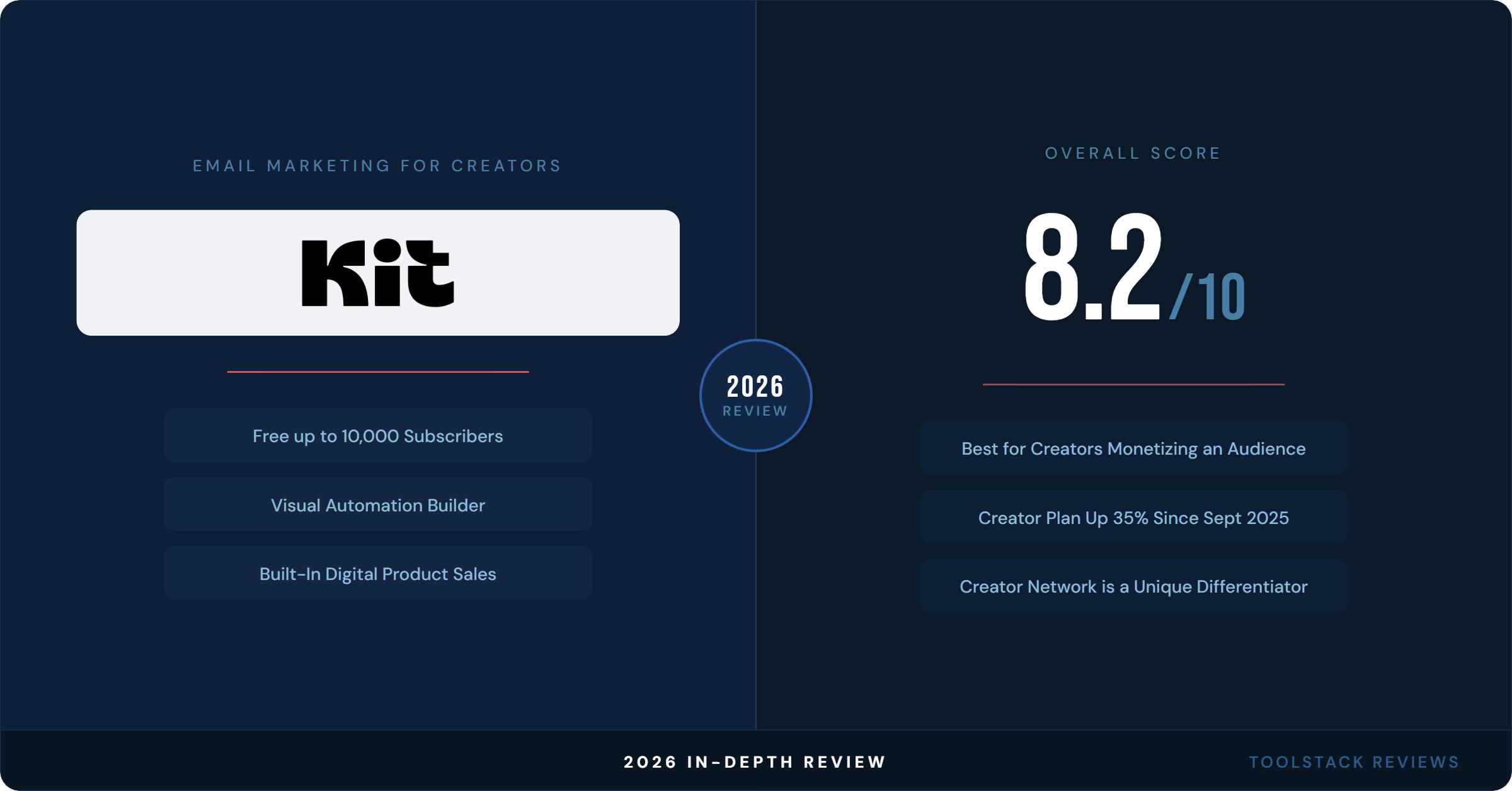
| Overall | 8.2 | Best for creators monetizing an audience, not for complex B2B automation |
Kit remains the strongest email platform built specifically for creators, but 2026 is not the year to assume the pricing you remember from two years ago still applies. Start on the free plan, confirm the automation builder is worth the jump to Creator, and check kit.com/pricing before you commit. Plans and prices on every SaaS product shift fast, and Kit is no exception this year. Ready to try it? Start your Kit trial here.
FAQ: Kit (ConvertKit) Review 2026
Is Kit still free for 10,000 subscribers in 2026?
Yes. The Newsletter plan remains free for up to 10,000 subscribers, with unlimited landing pages, forms, and email sends, though it includes only one automated sequence rather than the full automation builder.
How much does Kit cost per month in 2026?
Creator starts at $39/month billed monthly ($33/month billed annually) for 1,000 subscribers. Creator Pro starts at $79/month billed monthly ($66/month billed annually), also for 1,000 subscribers. Both scale up in price as your subscriber count grows.
Did Kit raise its prices recently?
Yes. The Creator plan’s monthly price rose from $29 to $39, about a 35% increase, in a change that rolled out around September 2025, according to user reports on Reddit and coverage from EmailOctopus.
Is Kit better than ActiveCampaign?
Not for every use case. ActiveCampaign offers more advanced automation, reporting, and CRM features, according to EmailToolTester’s 2026 comparison. Kit wins for creators who want a simpler tool built around audience monetization rather than complex sales pipelines.
What is Kit’s affiliate commission rate?
Kit’s affiliate program pays 30% recurring commission, according to third-party affiliate directories tracking the program in 2026. Confirm current terms directly at kit.com/affiliate before promoting, since commission structures change without much public notice.
⬇ FREE DOWNLOAD
Get The Lean Creator Stack
8 tool categories. Best free + paid picks for solopreneurs in 2026.