
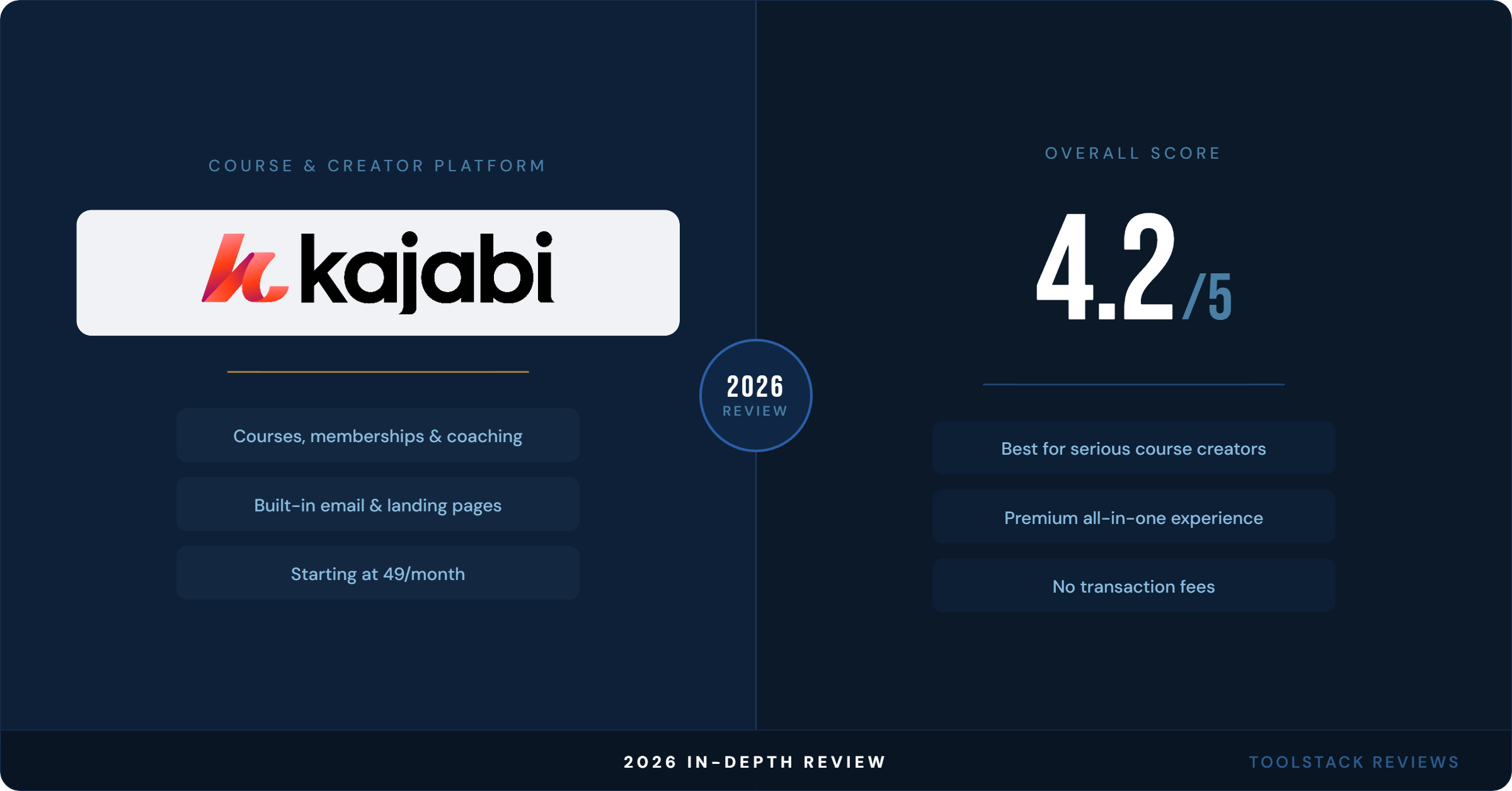
Last updated: May 2026
If you’ve spent more than five minutes in the online course space, you’ve heard the pitch: Kajabi is the all-in-one platform that replaces your entire stack. One tool for courses, email, landing pages, payments, and community. No patchwork. No duct tape.
That pitch is mostly true. But at $149/month for the entry-level plan, “mostly true” isn’t good enough — you need to know exactly what you’re getting, what you’re not, and whether the price is justified for where you are right now.
This review is based on verified 2026 pricing, live platform data, and third-party ratings. No fluff, no affiliate hype.
What Is Kajabi?
Kajabi launched in 2010 as a course platform and has since grown into a full creator business operating system. Today it combines online courses, coaching programs, digital downloads, memberships, community tools, email marketing, landing pages, sales funnels, and payment processing in one platform.
By the end of 2024, Kajabi creators had generated a cumulative $9 billion in revenue on the platform, with over $2 billion earned in 2024 alone, according to ElectroIQ’s 2025 statistics report. That’s not a niche tool — it’s a real ecosystem.
The core value proposition: instead of paying separately for Teachable (courses), Kit (email), Leadpages (landing pages), and ThriveCart (checkout), you pay one bill and manage everything from a single dashboard.
Kajabi Review 2026: Pricing Breakdown
Kajabi’s 2026 pricing sits across three main plans. Note: Kajabi raised prices in January 2026, and the Kickstarter plan ($89/month) was removed from public pricing — so many older reviews cite outdated numbers.
Current Plans (as of May 2026)
| Plan | Monthly Billing | Annual Billing | Products | Contacts |
|---|---|---|---|---|
| Basic | $179/mo | $143/mo | 5 | 2,500 |
| Growth | $249/mo | $199/mo | 50 | 25,000 |
| Pro | $499/mo | $399/mo | Unlimited | 100,000 |
A Starter plan also exists at reduced limits (1 product, 250 contacts) for new users testing the platform.
No transaction fees if you use Kajabi Payments. Every plan runs on standard credit card processing rates: 2.9% + $0.30 on Basic, dropping to 2.7% + $0.30 on Pro. However, if you use your own Stripe account instead of Kajabi Payments, Kajabi adds a platform surcharge: 2% on Basic, 1% on Growth, 0.5% on Pro. PayPal is exempt from this surcharge.
What the Annual Price Increase Means
The January 2026 restructure hit existing users hard. Growth jumped from $159/month to $199/month on annual billing — a $480/year increase. Pro went from $319/month to $399/month — an additional $960/year. Kajabi did not grandfather legacy customers, which generated significant backlash (multiple 1-star reviews on G2 and Trustpilot specifically cite this).
Hidden Costs to Watch
A few line items don’t show up in the headline price. On Basic, the branded mobile app costs an additional $199/month as an add-on. On Growth, it’s included. That means a Basic subscriber who wants a branded app actually pays $342/month — more than Growth at $199/month. API access costs $25/month extra on Basic; it’s included on Pro.
What You Get: Features by Plan
Basic ($143/month annual) — The Real Starting Point
Basic gives you 5 products, 2,500 contacts, 1 website, unlimited landing pages, unlimited marketing emails, funnels, and third-party integrations. Note: the affiliate program feature is only available on Growth and Pro plans — Basic does not include it. What it’s missing: advanced automations, video transcription, custom branding removal, webhooks, and 24/7 live chat support. You’re also limited to 2 admin users.
For most solo creators launching their first course or coaching program, Basic is enough — but the 2,500-contact cap is tight. Hit it and you’re either upgrading to Growth ($199/month) or paying to remove contacts you’ve worked to build.
Growth ($199/month annual) — Where Kajabi Gets Interesting
Growth is where the platform starts functioning like a real marketing machine. You get 50 products, 25,000 contacts, advanced automations, webhooks, the ability to remove Kajabi branding, and the branded mobile app included. You also get 11 admin users and 24/7 live chat support. This is the plan most serious creators should evaluate first.
Pro ($399/month annual) — For Scaling Operations
Pro adds 100,000 contacts, unlimited products, 3 websites, 3 communities, a custom code editor, and API access. At this level, you’re running a real business on Kajabi. The custom code editor and API matter if you’re building custom integrations or have a development team.
What Kajabi Does Well
Genuine All-in-One Coverage
The stack replacement argument holds up. A comparable setup — email marketing with Kit ($50–$100/month), landing pages with Leadpages ($49/month), a funnel builder ($97–$297/month), and a course platform like Teachable ($89/month) — runs $285–$545/month before accounting for integration overhead. Kajabi Basic at $143/month annual is cheaper, assuming you actually use the tools.
The trap, as noted by Jeff Cobb at LearningRevolution.net (April 2026), is paying for Kajabi and keeping all your old tools running in parallel. Either commit to the migration or don’t bother.
Email Marketing That Actually Works
Unlike most course platforms, Kajabi includes full email marketing — not just student notifications. You can send broadcasts to your entire list, build automated sequences, tag contacts by behavior, and run full sales campaigns. On Capterra (229 reviews, 4.3/5 overall as of 2026), email marketing is cited as one of the platform’s strongest features with 93% positive sentiment across reviewer mentions.
Course and Membership Builder
The course builder is solid. You get drip scheduling, cohort courses, quizzes, completion certificates, and video hosting included. The 2024 addition of cohort courses (live group learning with a start and end date) was a genuine product improvement, not a marketing rename. Kajabi creators sold 12 million courses in 2023, up from 9.1 million in 2021, per Kajabi’s own creator trends data.
Community Features
The community product has improved, but still draws mixed reviews. It works for basic engagement — posts, comments, circles — but if you’re used to Circle or Mighty Networks, you’ll notice the gaps. Community offers grew 65% between 2021 and 2023 (from 23,000 to 38,000), suggesting adoption is climbing even if the product isn’t best-in-class.
Where Kajabi Falls Short
Pricing at Scale
The honest math: Kajabi is competitively priced at the Basic level if you’re using most of what it offers. But as you grow, it gets expensive fast. Growth at $199/month and Pro at $399/month are hard to justify unless you’re generating meaningful revenue on the platform. A creator doing $2,000/month in course sales is spending 20% of revenue on the platform alone at the Basic level.
Design and Customization Limits
Kajabi’s templates look professional out of the box but hit a ceiling quickly. The website builder is block-based and relatively rigid. Custom code editing is locked behind the Pro plan. Several G2 reviewers specifically call out design limitations as a frustration — one 2-star review from a freelance marketing mentor describes the web design as “blocky” and customization as “limiting.”
Support Quality
This is a real issue. 24/7 live chat support is only available on Growth and Pro. Basic users get limited support access, and multiple recent G2 reviews mention 10+ minute wait times and unresolved issues even on higher plans. One 8-year customer (G2, 2026) left after Kajabi reversed grandfathered pricing commitments. These aren’t isolated complaints.
Content Lock-In Risk
Kajabi is a proprietary system. Migrating away is painful — there’s no clean export for courses, and video content hosted on Kajabi doesn’t export as raw files easily. One G2 reviewer (CTO, 0/5) described losing access after an account deactivation as a “migration nightmare” and switched to WordPress + MemberPress as a result. If data ownership matters to you, this is worth weighing upfront.
Kajabi vs. Teachable vs. Thinkific
The three platforms share the same core market but serve different needs.
| Platform | Starting Price (Annual) | Transaction Fees | Email Marketing | Best For |
|---|---|---|---|---|
| Kajabi | $143/mo | 0% (Kajabi Payments) | Full (any contact) | All-in-one marketing + courses |
| Teachable | $39/mo (7.5% transaction fee) | 7.5% on Starter | None | Budget-first course creators |
| Thinkific | $74/mo | 0% (TCommerce) | Students only | Learning-focused courses, B2B |
Teachable’s Starter plan at $39/month looks cheap — until you calculate the 7.5% transaction fee on every sale. At $3,000/month in revenue, that’s $225/month just in fees. Kajabi’s Basic at $143/month with zero transaction fees wins on total cost at that revenue level.
Thinkific beats Kajabi on course depth (better assessments, compliance tools, structured learning paths) but has no full email marketing — only sequences to students. If your business depends on building a list and marketing to it, Thinkific isn’t a replacement for Kajabi.
Ratings and Real User Feedback
Kajabi’s review profile is bifurcated. On Trustpilot (March 2026), it holds a 3.5/5 from 2,308 reviews — with 76% five-star ratings but a notable 9% one-star cluster, according to Ruzuku’s 2026 analysis. That pattern suggests very satisfied users and very frustrated ones, with little middle ground.
On G2 (2026), Kajabi has a 4.1/5 from 93 reviews. On Capterra (2026), it scores 4.3/5 from 229 reviews with an ease-of-use rating of 4.4/5. The value-for-money score on Capterra sits at 3.7/5 — the lowest subcategory — which tracks with the pricing feedback.
A meaningful data point from Kajabi’s own platform: the average six-figure creator on Kajabi has 4,000 email subscribers. Not 100,000 followers. 4,000 emails. This is the core argument for owning your audience rather than renting it from social platforms — and it’s why Kajabi’s email-first approach resonates with serious creators.
Who Should Use Kajabi
Kajabi makes sense if:
- You’re selling courses, coaching, or memberships and want one tool instead of five
- Email marketing is central to how you sell (funnels, sequences, broadcast campaigns)
- You’re generating at least $2,000–$3,000/month in digital product revenue and the math works out
- You want to skip technical setup and launch fast
It doesn’t make sense if:
- You’re pre-revenue and $143/month is a significant expense — start with Teachable’s $39/month plan or Thinkific’s free tier
- You need deep course customization, SCORM compliance, or advanced learning analytics
- You already have a mature tech stack that works and don’t want to migrate
- Content ownership and data portability are non-negotiable
ToolStack Verdict
| Category | Score | Notes |
|---|---|---|
| Ease of Use | 4.2/5 | Fast to launch, some nav friction at depth |
| Features | 4.0/5 | Broad coverage, some depth gaps vs. specialists |
| Value for Money | 3.6/5 | Justified at scale; hard to swallow pre-revenue |
| Email Marketing | 4.3/5 | Genuinely good for a course platform |
| Customer Support | 3.4/5 | Growth+ gets live chat; Basic support is weak |
| Overall | 4.0/5 | Best all-in-one for established creators |
Bottom line: Kajabi earns its price tag if you’re all-in on the platform and generating real revenue. The January 2026 price increase stings — Growth went from $159 to $199/month annually, and Pro from $319 to $399/month. If you were already a customer, that’s a hard pill. If you’re starting fresh and evaluating the full stack, $143–$199/month is defensible math for what you get.
The biggest risk isn’t the price. It’s lock-in. Once your courses, contacts, and automations live in Kajabi, leaving is a project. Go in knowing that.
Frequently Asked Questions
Does Kajabi charge transaction fees?
Kajabi does not charge platform transaction fees when using Kajabi Payments. Standard credit card processing fees apply: 2.9% + $0.30 on Basic, 2.8% + $0.30 on Growth, and 2.7% + $0.30 on Pro. If you use your own Stripe account instead, Kajabi adds a platform surcharge of 2% (Basic), 1% (Growth), or 0.5% (Pro). PayPal is exempt from the surcharge.
What happened to Kajabi’s Kickstarter plan?
Kajabi removed the Kickstarter plan ($89/month) from public pricing in January 2026 as part of a broader pricing restructure. Growth went up from $159/month to $199/month annually, and Pro from $319/month to $399/month annually. Existing customers were not grandfathered at old rates, which generated significant negative feedback.
How does Kajabi compare to Teachable on price?
Teachable’s Starter plan is $39/month but charges a 7.5% transaction fee on every sale. At $3,000/month in revenue, that fee alone adds up to $225/month — making Kajabi’s $143/month Basic plan (with zero transaction fees via Kajabi Payments) the more cost-effective option. Teachable’s paid plans from Builder ($89/month) onward remove the transaction fee.
Can I host a community on Kajabi?
Yes. All paid plans include at least one community. However, Kajabi’s community features are considered functional rather than best-in-class — reviewers frequently compare it unfavorably to dedicated platforms like Circle or Mighty Networks (which holds a 4.6/5 on G2 from 691 reviews). If community is your primary product, evaluate the dedicated tools before committing to Kajabi.
Is Kajabi worth it for beginners?
If you’re pre-revenue or just validating a course idea, the $143–$179/month Basic plan is hard to justify. Thinkific has a free plan for basic course hosting, and Teachable’s $39/month Starter plan is a lower-stakes way to start. Kajabi makes most sense once you’re consistently earning from digital products and want to consolidate your tools — the all-in-one math works better when you’re replacing real monthly expenses.
⬇ FREE DOWNLOAD
Get The Lean Creator Stack
8 tool categories. Best free + paid picks for solopreneurs in 2026.