
Last updated: June 2026
This is one of the most mismatched comparisons in SaaS marketing. Leadpages and ClickFunnels show up in the same searches, get recommended in the same Facebook groups, and compete for the same budget — but they are built for different people doing different things. Choosing the wrong one doesn’t just cost you money; it costs you months of setup for a workflow that was never going to fit.
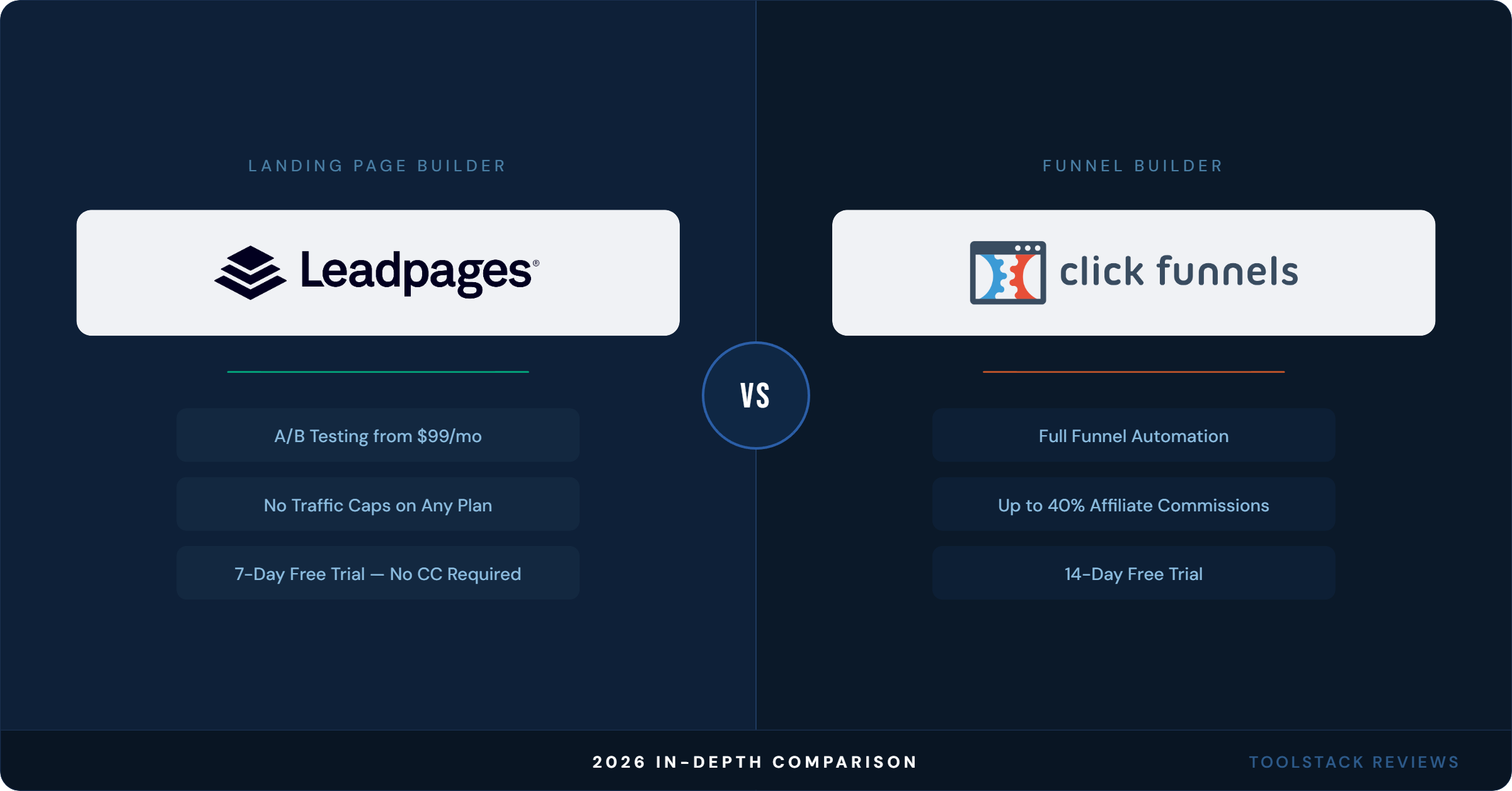
Here’s the short version: Leadpages is a landing page and conversion optimization tool. ClickFunnels is a full sales system with email, courses, checkout, and affiliate management built in. If you need to build pages that convert paid traffic, those tools point in very different directions.
This comparison covers verified 2026 pricing, real feature differences, and a clear verdict for solopreneurs trying to figure out which one actually earns its spot in their stack.
What Each Tool Actually Does
Leadpages has been a landing page builder since 2012. Its 2025-2026 repositioning added AI page creation, built-in heatmaps, dynamic text replacement, and automated A/B testing — making it a proper CRO platform, not just a page builder. The key stat from their own positioning: no traffic caps on any plan, while competitors like Unbounce cap at 20,000 visitors per month at $99/mo and Instapage caps at 15,000.
ClickFunnels started as a funnel builder in 2014 and has expanded aggressively. The current platform includes email marketing, a CRM, built-in course and community hosting, checkout with order bumps and upsells, an affiliate center, and a unified inbox for customer messaging. It is genuinely close to an all-in-one business operating system for solopreneurs selling digital products.
The overlap is real but narrow: both can build landing pages. Everything else diverges sharply.
Leadpages vs ClickFunnels: 2026 Pricing
Leadpages Pricing (verified June 2026 at leadpages.com/pricing)
- Grow — $99/mo (save 20% annually): 500 pages, 10 custom domains, unlimited traffic, A/B testing with up to 6 variants per page, dynamic text replacement, lead enrichment (2,000 IPs/mo), 5 active integrations, 40,000 AI credits/mo, 5 team seats. 7-day free trial, no credit card required.
- Optimize — $199/mo: Everything in Grow, plus built-in click and scroll heatmaps, Smart Traffic (AI routes visitors to the highest-converting variant automatically), auto-personalization, ICP audience targeting, 25 active integrations, 80,000 AI credits/mo, 10 team seats.
- Scale — $399/mo: Everything in Optimize, plus continuous AI-driven auto-optimization (tests and picks winners without manual input), 30 custom domains, 100 active integrations, dedicated customer success manager, 25 team seats, 160,000 AI credits/mo.
A/B testing is included on the Grow plan — a meaningful advantage. Competitors like Unbounce and Instapage gate split testing behind $149–$249/mo plans.
ClickFunnels Pricing (verified June 2026 at clickfunnels.com/pricing)
- Launch — $97/mo ($81/mo billed annually): 1 brand workspace, 2 team members, 10,000 email contacts, 50,000 emails/month, 3 courses and 3 communities, 5 custom domains, 1 store. Includes standard support and group onboarding. No webhooks, no API access, no affiliate center on this tier.
- Scale — $197/mo ($164/mo annually): 5 brand workspaces, 5 team members, 75,000 contacts, 300,000 emails/month, full API access and webhooks, affiliate center, automations, priority live chat support. This is the most popular plan.
- Optimize — $297/mo ($248/mo annually): 10 brand workspaces, 10 team members, 150,000 contacts, 750,000 emails/month, advanced workflows.
- Dominate — $5,997/year: 20 brand workspaces, dedicated IP for email, SSO, branding removal, account manager, 3-hour private onboarding, 400,000 contacts.
ClickFunnels includes a 30-day money-back guarantee and charges no transaction fees. Note: API access, webhooks, and the affiliate center require the Scale plan ($197/mo) — the Launch plan locks these out.
Feature Comparison: Where They Actually Differ
Landing Page CRO
Leadpages wins this category by a wide margin. Built-in heatmaps are available at the $199/mo Optimize plan — no Hotjar subscription required. Dynamic text replacement (swapping ad copy into the page dynamically based on URL parameters) is available from the $99/mo Grow plan. ClickFunnels has basic A/B testing on all plans but no heatmaps, no DTR, no Smart Traffic, and no auto-optimization. Achieving equivalent CRO capabilities on ClickFunnels requires adding Hotjar ($39–99/mo) and doing manual variant management — the comparison page from Leadpages estimates a total CRO stack on ClickFunnels running $186–485/mo.
According to Leadpages’ own comparison data (verified March 2026), ClickFunnels pages load at 5–9 seconds on GTmetrix testing, while Leadpages runs on Cloudflare’s edge network. Page speed directly affects Quality Score in Google Ads, so for paid traffic campaigns, this is a material difference — not a spec sheet footnote.
Sales Funnel & Commerce Features
ClickFunnels wins here. Leadpages connects to Stripe and PayPal for basic checkout, but it does not have native order bumps, one-click upsells, subscription management, or multi-gateway routing. ClickFunnels has all of these, plus a built-in affiliate center (on Scale and above) and Smart Checkout with AI-assisted payment routing.
If your business model is selling a $497 online course through a webinar funnel with an order bump and a follow-up email sequence, ClickFunnels handles that without third-party tools. Leadpages would require Stripe + an external email platform + a course tool like Kajabi or Teachable — and that stack gets expensive fast. (If course platforms are on your radar, the full Kajabi review is worth reading alongside this one.)
Email Marketing
ClickFunnels has email built in across all plans. The Launch plan includes 50,000 emails/month to up to 10,000 contacts. Leadpages has no native email sending — you connect it to your existing ESP (Mailchimp, ActiveCampaign, ConvertKit, etc.). For solopreneurs who already have an email setup, that is not a problem. For someone starting fresh who wants one platform, ClickFunnels removes one vendor from the equation. See our roundup of email marketing tools if you are evaluating ESPs separately.
Courses, Communities, and Memberships
ClickFunnels includes course and community hosting on all plans — 3 courses and 3 communities on Launch, scaling up with higher tiers. Leadpages has no course hosting or membership features. Full stop.
Ratings and Reviews
According to Capterra (verified June 2026), Leadpages holds a 4.5/5 rating across 302 reviews, with ease of use rated 4.5 and features rated 4.3. ClickFunnels holds a 4.5/5 across 666 reviews on Capterra, with features rated 4.5 and value for money rated 4.1. On G2, ClickFunnels has 417 reviews averaging 4.6/5. Both platforms score similarly overall — the meaningful difference is that ClickFunnels reviewers more commonly flag pricing and technical stability, while Leadpages reviewers more commonly flag template customization limits and billing policy complaints.
Who Should Choose Leadpages
Leadpages is the right tool if you are running paid traffic campaigns — Google Ads, Meta, YouTube — and conversion rate is your primary metric. You get unlimited traffic, A/B testing starting at $99/mo, dynamic text replacement on every plan, and built-in heatmaps at $199/mo without bolting on separate tools. The 7-day free trial requires no credit card, which is a low-friction way to test it.
It also makes sense if you already have an email platform, a payment processor, and possibly a course tool — and you just need a fast, high-converting front door for your campaigns. Leadpages plugs into your existing stack cleanly. It does not try to replace everything.
According to Capterra reviewer demographics (April 2026), 94% of Leadpages users are at small businesses, with 36% in marketing roles. The platform is clearly oriented toward marketers who live inside paid acquisition, not generalist business builders.
Who Should Choose ClickFunnels
ClickFunnels is for solopreneurs building a direct-to-consumer digital product business — courses, coaching, memberships, info products. If you want email, pages, checkout, courses, and an affiliate program all in one place without stitching together five different tools, ClickFunnels is the closest thing to a complete system at the $197/mo Scale tier.
Be aware of the constraints. The Launch plan ($97/mo) caps email contacts at 10,000 and removes API access, webhooks, and the affiliate center entirely — those require Scale. If you have an existing list close to or above 10,000 contacts, the Launch plan is not viable. The Scale plan at $197/mo is effectively the real entry price for a functioning business setup.
ClickFunnels is a poor fit if your primary goal is CRO on paid traffic. The page speed issues, lack of heatmaps, and absence of dynamic text replacement mean you would need to add external tools anyway — at which point, the cost comparison shifts.
ToolStack Verdict
| Criterion | Leadpages | ClickFunnels |
|---|---|---|
| Landing Page CRO | ⭐⭐⭐⭐⭐ | ⭐⭐⭐ |
| Sales Funnel Features | ⭐⭐ | ⭐⭐⭐⭐⭐ |
| Built-in Email | ❌ | ⭐⭐⭐⭐ |
| Courses & Memberships | ❌ | ⭐⭐⭐⭐ |
| Ease of Use | ⭐⭐⭐⭐⭐ | ⭐⭐⭐ |
| Value for Paid Traffic | ⭐⭐⭐⭐⭐ | ⭐⭐⭐ |
| All-in-One Value | ⭐⭐ | ⭐⭐⭐⭐ |
| Entry Price | $99/mo | $97/mo |
| Free Trial | 7 days (no CC) | 14 days |
Bottom line: If you buy traffic and care about conversion rates — use Leadpages. If you sell digital products and want email, checkout, and courses in one place — use ClickFunnels at the Scale tier ($197/mo). If you try to use ClickFunnels as a CRO tool or Leadpages as an all-in-one sales system, you will be fighting the product instead of using it.
Frequently Asked Questions
Is Leadpages cheaper than ClickFunnels?
The entry prices are nearly identical — Leadpages starts at $99/mo and ClickFunnels starts at $97/mo (Launch plan). The real cost difference shows up when you factor in what you need to add externally. ClickFunnels Launch locks out API access, webhooks, and the affiliate center, making the Scale plan at $197/mo the practical starting point for most businesses. Leadpages Grow at $99/mo includes A/B testing, dynamic text replacement, and lead enrichment — features that cost $149–$249/mo to unlock on competing page builders. Pricing verified at both official sites in June 2026.
Does Leadpages have built-in email marketing?
No. Leadpages is a landing page and CRO platform — it connects to your email provider (Mailchimp, ActiveCampaign, ConvertKit, etc.) via direct integrations and Zapier, but it does not send email campaigns itself. If you need email included in one platform, ClickFunnels includes it across all plans.
Can ClickFunnels replace a landing page tool like Leadpages?
For basic landing pages, yes. For serious CRO work — A/B testing, dynamic text replacement, heatmaps, traffic routing, and auto-optimization — no. ClickFunnels has basic split testing but lacks heatmaps (you would need Hotjar), DTR, and Smart Traffic features. For teams spending $5K+ per month on paid ads where conversion rate differences directly impact ROI, Leadpages is the more capable tool.
What is ClickFunnels’ contact limit on the basic plan?
The Launch plan ($97/mo) caps email contacts at 10,000 and email sends at 50,000 per month. The Scale plan ($197/mo) raises those limits to 75,000 contacts and 300,000 emails/month. The Optimize plan ($297/mo) allows 150,000 contacts. Pricing and limits verified at clickfunnels.com/pricing in June 2026.
Does Leadpages have a free plan?
No free plan exists. Leadpages offers a 7-day free trial with no credit card required — full platform access, no feature restrictions. If you do not subscribe after the trial, your account pauses and your pages stay saved. ClickFunnels offers a 14-day free trial on its Launch, Scale, and Optimize plans. Neither platform has a permanent free tier.
⬇ FREE DOWNLOAD
Get The Lean Creator Stack
8 tool categories. Best free + paid picks for solopreneurs in 2026.